Technical Brief: Solving Design challenges for a Pallet Tracking Device

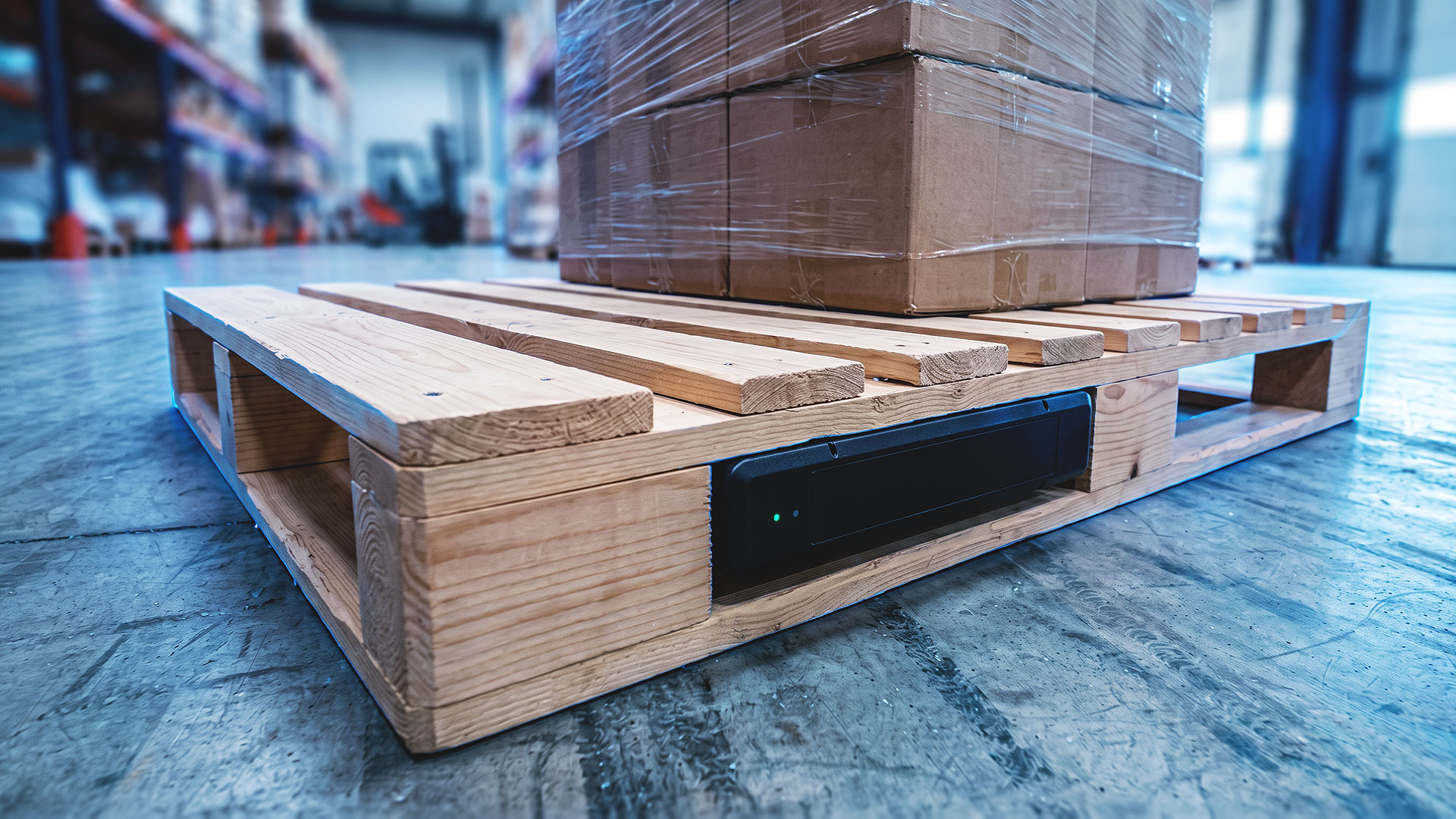
Pallet tracking is a challenging RF environment. A tracker must determine its position outdoors, maintain visibility inside warehouses, as well as transmit/receive data - all while operating for years on a limited battery. Because the device is frequently placed next to shifting cargo like metal, foil packaging, containers of liquids, its RF environment is unpredictable. This technical brief describes the integration of 3 Antenova antennas into a pallet tracker: GNSS for positioning outdoors, Cellular/LTE, and 2.4GHz for data transfer using WiFi/Bluetooth® as well as indoor tracking.
The RF Environment around a Pallet
The PCB ground plane, matching networks, battery, enclosure, and cargo collectively form the radiating system. Metallic cargo reflects or absorbs RF energy, while high-water-content materials introduce severe dielectric loading. As well as stacking pallets inside a trailer creates additional RF issues. These detuning factors must be addressed during initial mechanical and PCB layout phases before enclosure tooling is finalized.
Antenova receives high performance from these antennas:
| Antenna Element | System Function | Frequency Coverage | Key Specifications & Dimensions |
| Aurata SR4L112 | Cellular LTE | 698-960 MHz & 1710-2700 MHz | 28 × 10 × 3.3 mm; up to 68% efficiency; 5.6 dBi peak gain. |
| Serica SR4W035 | Local 2.4 GHz Links | 2400-2500 MHz | 6 × 4 × 0.4 mm; >65% average reference efficiency; 3.5 dBi peak gain. |
| M20057-1 | GNSS Signals | 1559-1610 MHz (L1 Band) | 7 × 7 × 0.9 mm; active module with integrated SAW filter & LNA; 18.5 dB gain. |
GNSS provides precise outdoor fixes but is not used inside warehouses or metal containers. Conversely, 2.4 GHz local links (Bluetooth®/Wi-Fi) are used for tracking indoors but lack wide-area coverage. A tracker reduces power consumption with use of intelligent firmware to adapt its positioning and communication behavior dynamically based on real-time signal environments.
Aurata: LTE/Cellular Antenna
The Aurata surface-mount FR4 antenna operates on the LTE bands globally.
- Integration Challenge: The antenna performance depends on the length of the ground-plane, in the bands below 1GHz. Shortening the PCB or placing the antenna close to the battery introduces severe performance degradation.
- Power Optimization: Optimizing this antenna efficiency extends battery life. A poorly integrated antenna degrades the uplink margin, forcing the cellular modem to operate at higher transmit power and repeat failed transmissions.
Serica SR4W035 Antenna
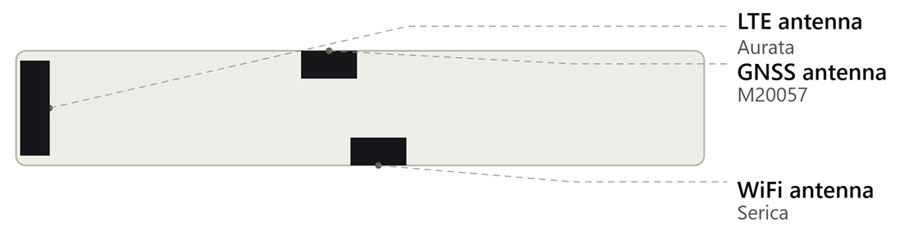
Serica works with all radio protocols in the 2.4-2.5GHz band (e.g. Bluetooth®/Wi-Fi). Serica is a loop antenna, so it is mounted in the center of the long edge of the PCB. It has high efficiency, giving long range with Bluetooth® modules.
M20057-1: GNSS Antenna
The GNSS receiver is susceptible to on-board noise from switching regulators, clocks, and cellular transmitters. The M20057-1 addresses this by integrating a SAW filter before its low-noise amplifier (LNA), the SAW rejects out-of-band signals before they desensitize the receiver.
Layout Requirements: The module requires a strict 7×5 mm clearance area through all PCB copper layers. It should ideally be positioned near the center of a long PCB edge on the surface, most likely to face outward toward open space.
System Implementation & RF Coexistence
Trackers do not run all three radios simultaneously. During outdoor transit, the device periodically powers up the GNSS and cellular to calculate and report movement, remaining asleep between intervals. Upon entering a warehouse and losing GNSS quality, the firmware suspends satellite searches and switches to local 2.4 GHz beaconing or gateway interaction to inherit local building context.
To prevent cellular transmissions from desensitizing the GNSS receiver and to resolve local 2.4 GHz proximity issues, designers must follow five strict implementation rules:
- Isolate each Antenna: Place the cellular and 2.4 GHz elements on different PCB edges. Isolate the GNSS module with its specific outward-facing clearance geometry.
- Reserve Matching Footprints: Include accessible tuning networks for all three RF paths. Never rely on default evaluation-board values for the final enclosed product.
- Control RF Return Paths: Maintain continuous ground planes and short connections to matching-component ground vias. Never route high-speed digital lines through antenna clearance zones.
- Protect the GNSS Supply: Because the M20057-1 shares its RF output and DC power on a single pin, implement a clean reference bias network with an RF choke to prevent supply noise from degrading GNSS sensitivity.
- Coordinate in Time-Domain: Program the firmware to strictly avoid active GNSS acquisition during high-power cellular transmissions.
Field Valuation and Testing
Bench-testing an exposed PCB is insufficient for final validation. The completed device must be evaluated inside its final plastic housing while mounted directly to a representative wooden pallet.
- Cellular Validation: Measure total radiated power (TRP) and total isotropic sensitivity (TIS) across all target bands.
- GNSS Validation: Record time to first fix (TTFF), signal strengths, and position quality in different scenarios.
- 2.4 GHz Validation: Measure the range to receive data packets, and check there are consistent connections to the gateway in a typical warehouse scenario.
True tracking reliability stems from system-level engineering - ensuring hardware placement, coexistence filtering, firmware scheduling, and over-the-air (OTA) testing operate as a single unified platform.
Summary
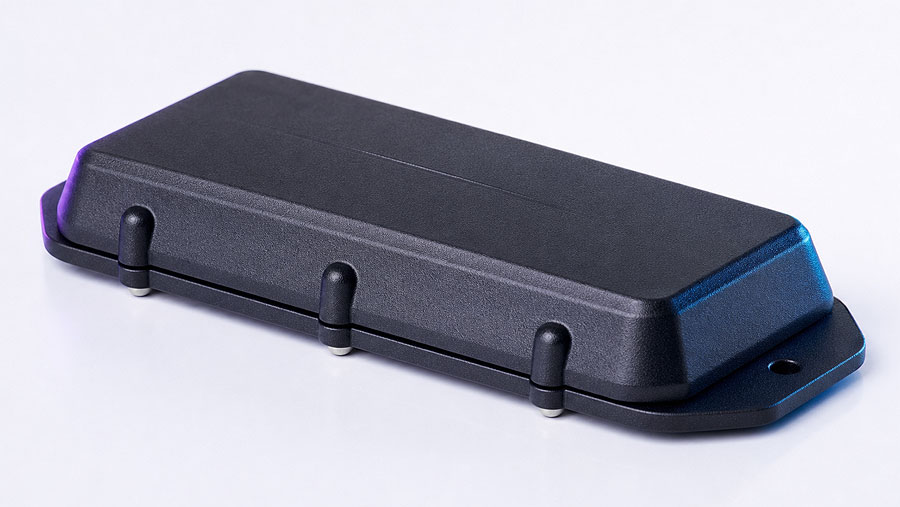
Antenova has recently launched the Aurata antenna, this antenna is designed to work on long/thin PCBs, these PCBs are used by pallet trackers. The typical PCB length for a pallet tracker is 160mm, this allows for the batteries to take up the bottom section of the PCB. Compared to other types of LTE antennas, Aurata has better performance on long/thin PCBs. See more details on Aurata.
Talk to Our Antenna Experts
Visit our Product Detail Pages where you will find datasheet, footprint, and 3D models. In addition, you can request a sample and a quote, check distributor availability, and try out the Antenna Placement Tool.
Need support with antenna integration or looking for a custom solution? Our engineering teams are ready to help with design, optimisation, testing, and sample selection for your wireless project. Let´s talk about your request.
or Join our global antennas & wireless design community at ask.antenova forum. This is an opportunity to communicate directly with our top engineers as well as community members.
View related articles:
6 difficulties of designing portable tracking devices
Integration tips for GPS/GNSS receiver modules
4 ways to increase wireless antenna performance in metal devices